
About KHOJ
KHOJ International Artists' Association is a registered, autonomous artist led initiative which was set up in 1997. It is part of the global Triangle Arts Trust. Since its inception, its direction has been towards creating an alternative forum for experimentation and exchange within contemporary art practice. It has sought to facilitate the empowerment of the so called third world artists and their cross-cultural bonding beyond racial prejudices and for an exchange of information along alternative lines. Over the past 9 years, artists from Iran, Egypt, Cuba, Argentina, Singapore, Thailand, Japan, Mainland China, Taiwan and several countries in Africa, have participated in our workshops and residencies. As a deliberate policy, our core invitees have been from South Asia resulting in the development of a regional network.
Programs & Activities
KHOJ undertakes a wide range of activities, which include:
Developing a wide range of projects and programs which, articulate interactions between diverse group of artists, geographies and cultural contexts.
Organizing events which encourage critical debate, diversity and innovation within art.
Actively facilitating initiatives under the aegis of the KHOJ National Network: in nodal points across the country, Mumbai, Guwahati, Kolkata
and Bangalore.
KHOJ’s current goals are:
To actively assist, develop and promote new, investigative and experimental art practices; in all media (ephemeral art practices such as sound art, performance, experimental theatre etc. installation, public art and multi-media work).
To promote discussion, understanding and appreciation of contemporary arts issues and to provide a forum for critical debate.
To encourage and support the production and the exchange of ideas by Indian, South Asian and International artists through production, exhibition and dissemination.
To actively facilitate an informal network of contemporary artists both within the region and within the larger Global South.
To develop new and informed audiences.
To support emerging artists and artists from smaller cities/marginalized areas.
About Desire Machine
Desire Machine arises from the need to replace the paranoid, capitalist, neurotic with schizoanalysis: a molecular, schizophrenizing point of view that sets free the autoproductive unconscious. Rather than linking dependent parts into a functioning whole, desiring machines involve heterogeneous "parts" in a connective synthesis. The unconscious is a factory rather than a theater. The unconscious constructs machines, which are machines of desire, whose use and functioning schizoanalysis discovers in their immanent relationship with social machines. The unconscious does not speak, it engineers. It is not expressive or representative, but productive. A symbol is nothing other than a social machine that functions within the social machine, an investment of the social machine by desire
Working together as Desire machine from 2004, are Sonal Jain and Mriganka Madhulaillya. Working in varied art practices ranging from photography, multimedia to video and film, they constantly strive to redefine the form and meaning, art practice takes in relation to the changing contexts.
Sonal Jain is a fine arts graduate from the Maharaja Sayajirao University of Baroda, (1994- 1998). She then worked as a Faculty in Communication Design at the National Institute of Design, Ahmedabad from 1999 to 2002.
Mriganka Madhulaillya, a Physics graduate from the Fergusson College, Pune (1996 - 1999), did his Post graduation in Film and Video from the National Institute Of Design, Ahmedabad in the years 2001 to 2003. He is also currently a teacher at the Indian Institute of Technology Guwahati.
Workplan 2007-2008 to Arts Network Asia (ANA) for development of art project ‘Peri-ferry’
KHOJ applied to Arts Network Asia for a grant for a period of 2 years to develop an arts project with the artists’ collective Desire Machine in Guwahati in the north east of India. Over the past year, KHOJ has actively facilitated high caliber local and international art projects in Guwahati with a focus on seeding and supporting self-organizing structures under the KHOJ project. By providing an open and flexible structure for the production of new work, KHOJ has continued to serve as a catalyst for the production of new work in new contexts. Established as well as emerging practitioners have been engaged, with a commitment to realizing projects on a range of scales and in a diversity of locations.
The project kick-started with visits by KHOJ Director, Pooja Sood and KHOJ National Network Coordinator, Akshay Pathak to Gawahati to initiate the project with detailed discussions on the events planned and the evaluation mechanisms for the same. The subsequent months involved coordinating the administrative setting up as well as liaising with all three coordinators to plan and start the residencies or other activities as mentioned in the work plan sent earlier.
Regular reports on a monthly basis were sent by the Desire Machine Collective to KHOJ Delhi to apprise of the developments. Telephonic discussions were held from time to time to evaluate the progress of the project.
1. DESIRE MACHINE@ KHOJ GUWAHATI
July-December 2007
Mrignaka Madhukaillya and Sonal Jain participated in a month long residency in April 2005 at the KHOJ studio. Over several conversations and an active understanding of the way in which KHOJ functions, the idea of a project based forum in Gawahati was seeded.
Sonal Jain who is also an artist herself and one of the founders of Desire Machine Collective was appointed as the co-ordinator for the Guwahati initiative. It was decided to name the chapter there as Desire Machine Collective @ Khoj Guwahati.
A residency-cum-office space was identified which could house three artists and also act as an office space. The initiative now runs out of that space. There was a lack of basic infrastructure in the space which was then made possible from an additional grant from Khoj International Artists’ Association whereby a computer and other such office paraphernalia were provided to the office.
The first residency planned was an associate residency with a British artist, Bruce Allan.
http://www.axisartists.org.uk/artist/bruceallan
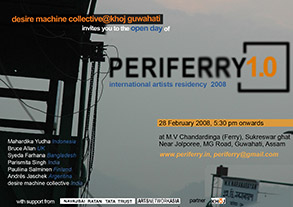
Periferry 1.0 Project
The objective of the project is to create a temporary nomadic E-lab for creative practitioners on a ferry on the river Brahamaputra, the most important river in the region flowing through, China, Tibet, India, Bangladesh and into the Bay of Bengal. A site-specific event on and about the river and its network has been conceptualized the "Periferry 1.0", project has been initiated by Sonal Jain and Mriganka Madhukaillya, artists and filmmakers from Northeast India.
The "Periferry 1.0” project creates a forum for discourse on the notion of borders and explores an alternative imagination of cross-border transaction along South/ Southeast Asian borders. It provides an alternative space, which is the impetus for transforming cultural productions. A space for artists interested in furthering inquires into notions of self, identity, borders, nationality and cross-cultural encounters.
Program Schedule:
Residency: "Periferry 1.0", starts with a 6-week residency program, which begins on the 14 January and ends on 29 February 2008. There will be 7 artists participating, 2 from India and 5 international. They are Syeda Farhana (Bangladesh), Parismita Singh (India), Sonal (India), Bruce Allen (England), Pauliina Salminen (Finland)-Andreas (Argentine) & Mahardhika Yudha (Indonesia)
International Conference: The participants will attend the International Conference on Northeast India and its Transnational Neighbours, which begins on the 16 Jan 2008 and ends on the 18 Jan 2008. The conference is being organized by Asian Borderlands Research Network, Indian Institute of Technology (Guwahati, India), Centre for Policy Research (New Delhi), International Institute for Asian Studies (Leiden, The Netherlands). The venue for the conference is Institute of Technology (Guwahati, India)
Film Screening & Exhibition: A program of film screening will run parallel to the conference, in addition to a visual exhibition, "Inner Lines", by Desire Machine Collective @ KHOJ Guwahati, organized in cooperation with Panos South Asia. Curated by Mriganka Madhukaillya, Date: 16-19 Jan 2007, Venue: ITA Centre, Guwahati, Assam, India.
Open Day: The open day has been scheduled 28 February 2008.
The final list of artists identified is as follows:
1 Syeda Farhana, - Bangladesh
2 Mahardhika Yudha - Indonesia
3 Parismita Singh – India
4 Mriganka/Sonal Jain- India
5 Bruce Allen – England
6 Pauliina Salminen – Finland
7 Andreas – Argentina
With the actual event planned to launch in mid January the initiative in Guwahati has already been creating a buzz not just in the region but internationally as well. There have been inquiries and interest from various artists, local as well as international who have shown keen interest in developing projects around the idea of Periphery as outlined by Desire Machine Collective@KHOJ Guwahati.
Program Schedule International Conference on Northeast India and its Transnational Neighbourhood
Start: 2008-01-17 09:00
End: 2008-01-18 18:00
Timezone: Etc/GMT
Venue: [IIT] Indian Institute of Technology Guwahati, Assam, India
It is often said that 99% of Northeast India's borders are with foreign countries: Tibet, Burma [Myanmar], Bangladesh and Bhutan. There are many aspects of Northeast Indian life that would make sense if considered from a transnational perspective, yet the current organization of academic knowledge seems ill equipped to address the intellectual challenges of such an approach. In order to contextualise the cultural, social and political dynamics of the region, our view needs to extend beyond political boundaries.
This interdisciplinary conference will provide a forum for scholars and policy makers, as well as visual artists and others involved in the material and visual representation of this region. All scholars who are currently, or have previously been actively involved in research in this region are invited to participate, irrespective of nationality. However, it is hoped that scholars from countries such as India, China, Bangladesh, Burma and Thailand will make a significant contribution.
We solicit papers focusing on any of the following topics, but will consider papers that address other issues:
1) Asian Perspectives on Northeast India.
The countries that surround Northeast India share much common ground when it comes to culture, environment and economy. Yet, political, cultural, religious and social systems also differ, as do approaches towards the various challenges that these governments face at home. This raises the question of how Northeast India is perceived from its near abroad, and how these perceptions influence relations with this area. When do interests combine, and how can possible disagreements be resolved in order to facilitate balanced and sustainable development in the region?
2) Assessing recent India-Southeast Asia interactions: comparing India's Look-East Policy and Chinese dealings with transnational space.
India and China are presently consolidating their positions as regional powers. This involves developing initiatives aiming for the intensification of trade and travel across a region that has for decades been economically at the periphery of these states. How are these initiatives received locally, and what counter-currents emerge?
3) Beyond tribes and plainsmen: the historical dynamics of hills-plains interactions in the South, East, Central and Southeast Asian borderlands.
Both colonial and local socio-political discourses have long emphasised the distinctiveness of plains dwellers vs. hill ‘tribes'. Yet the relationships between the people of the hills and the plains were/are far more multidimensional than is often assumed. How are these more complex relationships best understood and represented? What kind of historical and contemporary contingencies have been significant in the interplay between highland and lowland? Is there any value to this dichotomous representation of socio-political and cultural systems?
4) Social and religious transformations in Northeast India and its transnational neighbourhood. Northeast India and its transnational neighbourhood have experienced rapid and significant change over the last two centuries: the extension of primary education and elementary allophatic healthcare, transportation and communication for example, have resulted in once relatively isolated areas being connected to urban centres in new ways. In the hill regions in particular, social change typically went hand in hand with redefinitions of religious and ethnic identities. How can these rather hybrid transformational processes be understood? What commonalities exist(ed), and what were unique characteristics in relation to specific communities? How can a better appreciation of more wide-ranging methodological and theoretical issues be developed in relation to these subjects?
5) Developmental challenges for Northeast India from transnational perspectives
In Northeast India, conflicts regarding the control and management of natural resources and issues of social, political and economic concern, such as ecological degradation and high levels of HIV/AIDS infection, pose great challenges. How can these developmental challenges be approached? What can be learned from taking a transnational perspective?
6) Networks, routes and resources across borders
Historically, Northeast India has not been isolated from its transnational neighbourhood. People have been connected by trade routes and migration. Cultural and religious ideas have spread, and been accommodated with existing traditions. How are these historical relationships continuing in the present, transcending present-day political borders? What theoretical and methodological approaches can lead to a better empirical understanding of the nature and role of regional networks in communication, social practices, cultural and material representation and economics?
Organizers:
Indian Institute of Technology (Guwahati, India)
Centre for Policy Research (New Delhi)
International Institute for Asian Studies (Leiden, The Netherlands)
INNER LINES: A VISUAL EXHIBIT AND FILM SCREENING PROGRAMME
Curator: Mriganka Madhukaillya
Date: 16-19 Jan 2007
Venue: ITA Centre, Guwahati, Assam, India
Organized by: Panos south Asia
Co-organized by desire machine collective@Khoj Guwahati
Concept:
The main idea of the exhibition is definitely looking at borders as possible network space. The curation is going to be done by different artists and cultural activists looking at the possibilities and the other border realities and imaginations and dissolution of the dichotomy of these concepts and to liberation of plurality in terms of both identity and artistic practice. The exhibition is happening along with a international conference on transnationalism and borders along northeast India.The curation is divided into two parts :
1) A visual exhibit consisting of curation of works of:
1. Satomi matoba /Map of utopia (B1 size archival print of map)
2. Farhana Syeda/ migration series (photo series)
3. Bruce Allan/ new work on personal memory around tea (photographs and video)
4. Desire machine collective/ note book on geography(ies)--video
5. William van schendel/ photographs with text
6. Temsu Long kumer /photographs
7. Andreas &Paullina/ 2*3 borders/3 channel video/ video
2) Film Screening Program
a) FRAGMENTARY LANDSCAPES (2007) Kwang zu son
DV(shot in 16mm), Experimental/Documentary, Color/B&W, Sound, 7:10
Synopsis
FRAGMENTARY LANDSCAPES combines the artist's observations from the remote, intangible worlds and empty landscapes of the United States with a series of juxtapositions of different images and sounds. It becomes the practice of identification in which conveys the permanent unsettlement at different times and places.
THE THIRD TONGUE (2003)
16mm, Experimental, B&W, Sound, 14 min.
Synopsis
Through exploring the process of practicing English, the film THE THIRD TONGUE represents a fear engendered by a sense of loss of historical identity in post-colonial society.
b) Virtual borders/ Manu Luksch
c) Temporary loss of consciousness/ Monica Bhasin
Running Time: 35 Minutes /Year of Completion: 2005
'Temporary Loss of Consciousness' is a poetic essay speaking of longing and belonging, home and honour, loss and betrayal, boundaries and crossings. The film is shot in India and its shared borders of Pakistan and Bangladesh. It alludes to the recurring displacement of populations in the Indian subcontinent from the time of Partition (1947) to the present.
d) Himalayan Monogatari/ Shaina Anand
Documentary 34 mins.video. Japanese with English subtitles
A documentary on the physical and human landscape between the valleys of Kashmir and Ladakh, India. Encounter gods and demons, mystic mountains and lakes, contemporary fact and fiction in this journey through the Himalayas- accompanied by a genteel Japanese voice-of-godess. Structured as a televised 'serial' the film welcomes you back to another episode of Himalayan Tales, recapping the previous episode. What follows are a series of short vignettes that take you from Srinagar to Pahalgam, up the mountain route of the Amarnath Yatra, onwards to Kargil and Ladakh, the Nubra Valley and the great lakes Tso-mo-ri-ri and Tso-kar through recounting of tales and legends. The film ends in the 'pure' Aryan village of Da-hanu in Batalik, with a promise of more in the next episode. This simple structure and the use of Voice-of-God(dess) narration, with its naive and truncated sweeps across complex histories and civilisations, its calm and soothing belief in myth and beauty, and ultimately its reading as fact, all coupled with the slight and deliberate shifts in 'gaze' underlying the films progression allow for a meditative and transparent examinaton of documentary itself.
e) Aliyah/desiremachine collective:
2006, DV/documentary/sound/colour/26 mins
In a remote corner on the Indian- Burmese border, in Mizoram state, thousands live a suspended life. Most have left their jobs and schools, some have even left their families. They wait in silence to return to the promised land, Israel. The Mizos believe that they are one of the ten lost tribes of Israel, Bnei Menashe, descendants of Menashe, Joseph‘s son. The waiting unfolds as a religious ceremony, an endless ritual of prayers and a labyrinth of memories. In the midst of these lonely gatherings of the scattered people, their myths, imagination and experiences emerge as a historical fact of singular importance. The memories are explored through 3-4 characters. Itzkhak Colney has already migrated to Israel and is serving in the Israel army. Rivka or Rebecca has come to Aizwal for her father-in- law's funeral. She has now to get a tourist visa and an inner line permit (required by all non-Mizos) to enter the state. Peter has left his government job, as it did not give him time to practice his Jewish faith. Living on the nation‘s (India) margin they are migrants in exile, while in their imagination they are in exile from Israel.
f) PRAYERS FOR NEW GODS/ Moji Riba (2001)
An exploration of the indigenous religion of the tribal groups of Arunachal Pradesh, their adaptation to new religions and to a globalised notion of ‘God'.
g) The Lightning Testimonies/ Amar kanwar (2007)
Duration - 1 hour 56 minutes, 2007, English and Hindi versions.
The Lightning Testimonies reflects upon a history of conflict in the Indian subcontinent through experiences of sexual violence. As the film explores this violence, there emerge multiple submerged narratives, sometimes in people, images and memories, and at other times in objects from nature and everyday life that stand as silent but surviving witnesses. In all narratives the body becomes central - as a sit for honour, hatred and humiliation and also for dignity and protest.